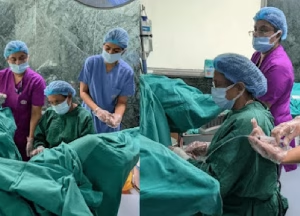
A historic milestone in regenerative medicine: Prof. (Dr.) Abha Majumdar and her clinical team achieve India’s first successful live births utilizing umbilical cord-derived mesenchymal stem cells to reverse severe uterine scarring.
A historic breakthrough in reproductive regenerative medicine has opened transformative treatment possibilities for women facing complex uterine infertility barriers. Doctors at the prestigious Sir Ganga Ram Hospital in New Delhi have reported India’s first successful live births following stem cell therapy for severe Asherman’s Syndrome. This pioneering clinical milestone offers a powerful, scientifically validated alternative to couples previously left with limited reproductive choices.
This groundbreaking clinical trial and successful delivery management protocol were directed by Prof. (Dr.) Abha Majumdar, Director and Head of the Centre of IVF and Human Reproduction. Her expert medical team successfully utilized clinical-grade umbilical cord-derived mesenchymal stem cells to repair long-standing intrauterine scar tissue and safely restore endometrial function required for a full-term pregnancy.
Asherman’s Syndrome is an intricate reproductive condition characterized by the formation of dense scar tissue (synechiae/adhesions) inside the uterine cavity. This structural damage often leads to partial or total obliteration of the uterine space. Clinically, these scarring patterns typically develop as secondary complications following invasive pelvic events:
In extensive, severe variations of this syndrome, the structural basal layer of the endometrium is entirely destroyed. Consequently, the uterine lining loses its capacity to thicken or respond to natural hormonal stimulation. Until recently, women with flat, non-responsive linings faced complete reproductive barriers, forcing them to rely exclusively on surrogacy or adoption pathways.
To overcome this absolute tissue barrier, Dr. Abha Majumdar’s clinical protocol utilized high-potency mesenchymal stem cells harvested carefully from the Wharton’s jelly of the umbilical cord. These specialized cells are globally recognized for their exceptional anti-inflammatory, immunomodulatory, and cellular regenerative capacities.
The highly detailed micro-surgical clinical sequence involves three distinct phases:
By safely targeting the core basal layer, the regenerative treatment triggers natural cellular repair networks. This process successfully restores the uterine environment’s capability to safely accept, attach, and sustain a developing embryo.
This dynamic breakthrough was achieved during a tightly controlled clinical trial monitoring ten patients diagnosed with advanced, severe forms of Asherman’s Syndrome. Out of the trial group, two patients have successfully delivered healthy babies after completing the intra-follicular tissue rejuvenation therapy:
| Patient Profile | Baseline Uterine Status | Clinical Stem Cell Outcome | Delivery Metrics |
|---|---|---|---|
| Case 1: 39-Year-Old | Severe, dense intrauterine adhesions with complete cessation of menstrual cycles. | Successful reduction of scar layers; restoration of normal tissue elasticity. | Delivered a healthy baby boy at 35 weeks, weighing 2 kg. |
| Case 2: 40-Year-Old | Recurrent pregnancy loss paired with a permanently thin, damaged endometrial track. | Marked improvement in tissue vascularity and steady endometrial thickness growth. | Delivered a healthy baby girl at 31 weeks, weighing 1.8 kg. |
Following the stem cell micro-infusion cycles, both trial participants achieved normal menstrual flows, sustained appropriate endometrial thickness metrics above critical thresholds, and experienced a massive reduction in adhesion recurrence vectors.
This therapeutic milestone demonstrates the immense clinical potential of regenerative medicine within modern fertility science. By actively reversing internal structural damage rather than simply bypassing it, stem cell protocols offer authentic hope to thousands of couples dealing with unexplained or structural uterine infertility.
As advanced global multi-center trials continue to confirm these safety and efficacy baselines, this specialized cell-infusion protocol is poised to become a core corrective option for severe intrauterine pathologies globally.
Prof. (Dr.) Abha Majumdar is widely regarded as an international pioneer in assisted reproductive technology (ART) and advanced pelvic microsurgery. As the Director and Head of the Centre of IVF and Human Reproduction at Sir Ganga Ram Hospital, she has spent decades resolving the most complex infertility cases. Notably, she was a key member of the historic medical team responsible for delivering the first successful IVF baby in North India in 1991.
Through her continuous contributions to academic clinical research and her dedication to evidence-based reproductive science, she remains committed to developing innovative treatments that turn the dream of parenthood into a reality for couples worldwide.
📺 Media Broadcast: Watch the complete clinical panel discussion aired exclusively on Zee News Network.
In a rapidly progressing global healthcare landscape, reproductive endocrinology continues to scale new heights, providing highly scalable clinical alternatives where traditional pathways face limitations. A key pillar among these modern innovations is In Vitro Fertilization (IVF)—a highly structured micro-assisted reproductive procedure that has successfully transformed millions of families worldwide.
In an exclusive television interaction broadcast by Zee News, India’s foremost fertility pioneer Prof. (Dr.) Abha Majumdar, working alongside clinical reproductive expert Dr. Neeti, addressed the public to demystify advanced embryological protocols, separate facts from societal misconceptions, and outline the emotional architecture of modern fertility cycles.
Modern IVF has evolved from a misunderstood, highly restricted procedure into an accessible, highly calculated clinical sequence for couples facing complex conception blocks. As explained during the broadcast, a standard controlled cycle follows a rigid four-stage medical protocol:
A major point clarified during the interview is that post-transfer care does not require complete or absolute bed rest. Patients are fully encouraged to safely resume their normal daily tasks while maintaining a few basic, healthy lifestyle modifications.
Addressing core success variations, Dr. Neeti highlighted that maternal biological age and functional ovarian reserve (indicated via AMH testing) remain the primary baseline indicators for initial cycle outcomes. Female patients under the age of 35 typically register significantly higher success rates due to a greater reserve of chromosomally normal eggs.
However, the panel strongly emphasized that fertility is a shared journey. Paternal semen factors—including sperm count, advanced motility dynamics, and DNA fragmentation indices—critically impact blastocyst development rates. Furthermore, high systemic stress levels can negatively influence hormonal balance, making comprehensive psychological support essential for achieving optimal outcomes.
A key focus of the television discussion centered on the rising adoption of Social Egg Freezing (Oocyte Vitrification). Modern career timelines and personal milestones often prompt women to safely delay family planning. This advanced preservation technique enables women to secure their prime reproductive cells during their peak biological years for use in future transfer cycles.
Professor’s Professional Quote: Social egg freezing represents a major advancement in reproductive autonomy. It provides women with a reliable scientific tool to protect their fertility choices, effectively neutralizing the pressures of the biological clock until they feel completely ready for motherhood.
The panel highlighted that undergoing a fertility cycle involves a complete mental, physical, and financial commitment. Navigating unexpected cycle shifts or past failures requires immense resilience, clear clinical guidance, and professional counseling to protect patient well-being.
Because top-tier fertility care utilizes highly complex laboratory technologies, couples should always select established institutional centers. Partnering with trusted experts ensures complete transparency regarding diagnostic pathways, safety guidelines, and treatment costs before starting a cycle.
The core message of the broadcast focused on removing outdated societal stigmas around fertility care. As public awareness grows, advanced reproductive treatments are no longer viewed as a confidential last resort, but as a standard, scientifically validated solution to a recognized medical condition.
Both Dr. Abha Majumdar and Dr. Neeti continue to champion transparent community conversations, encouraging families to embrace modern science-backed choices to experience the beautiful journey of parenthood.
By Prof. (Dr.) Abha Majumdar | Director & Head, Centre of IVF, Sir Ganga Ram Hospital
Infertility remains one of the most misunderstood medical conditions globally—often heavily clouded by social stigma, cultural pressure, and metabolic misinformation. Globally, estimates suggest that approximately 1 in every 6 couples of reproductive age experience some form of conception delay during their lifetime. Navigating this challenge requires a solid foundation of scientific facts rather than societal assumptions.
In reproductive medicine, infertility is classified as a specific medical condition affecting the reproductive system of either the male or female partner, or both. Clinically, it is diagnosed as the inability to achieve a successful pregnancy after 12 months or more of regular, unprotected sexual intercourse. The underlying causes vary dynamically: they may stem from maternal factors, paternal factors, a combination of both, or may be categorized as unexplained infertility after initial diagnostic screening.
Various health parameters, genetic traits, and lifestyle choices can directly impact reproductive capacity. Fortunately, proper education, timely diagnostic testing, and specialized interventions—such as Intrauterine Insemination (IUI) and In-Vitro Fertilization (IVF)—provide highly effective pathways for couples looking to build their families.
Beyond the biological hurdles, infertility introduces a heavy emotional and social burden, particularly within deeply traditional socio-cultural settings like India. Despite clear medical data showing that reproductive challenges affect both sexes, a highly biased social perception often treats infertility as an exclusively female problem.
This systemic misunderstanding leads to immense emotional distress, anxiety, isolation, and low self-esteem for women. Addressing infertility openly as a shared, treatable medical condition is essential for promoting gender empathy and dismantling harmful societal taboos.
Dismantling common misconceptions allows couples to skip ineffective alternative routes and seek appropriate, evidence-based medical care early on:
Medical Fact: Infertility affects men and women equally. Clinical statistics show that paternal factor infertility accounts for approximately 50% of all documented cases, either as the sole diagnostic cause or alongside maternal factors. Comprehensive evaluation must involve both partners simultaneously.
Medical Fact: While extreme stress can negatively alter hormonal balances, clinical infertility is rooted in concrete physical barriers (such as blocked fallopian tubes, low sperm counts, or ovulatory disorders). These conditions require targeted medical intervention, not just relaxation techniques.
Medical Fact: IVF is an advanced reproductive milestone, but it is rarely the first or only treatment option. Many couples conceive using simpler first-line therapies, including ovulation induction medications, corrective surgeries, or structured IUI procedures. IVF success rates vary based on maternal biological age, ovarian reserves, and overall health profiles.
Advancements in reproductive endocrinology offer a wide range of treatment options customized to each couple’s unique diagnostic profile:
Education is our most powerful tool for breaking down historical stigmas. By understanding the objective medical facts of human reproduction, couples can avoid unnecessary self-blame, seek professional guidance without hesitation, and make informed choices for their future families.